
OpenAI and Google: A Duel for the Soul of Artificial Intelligence
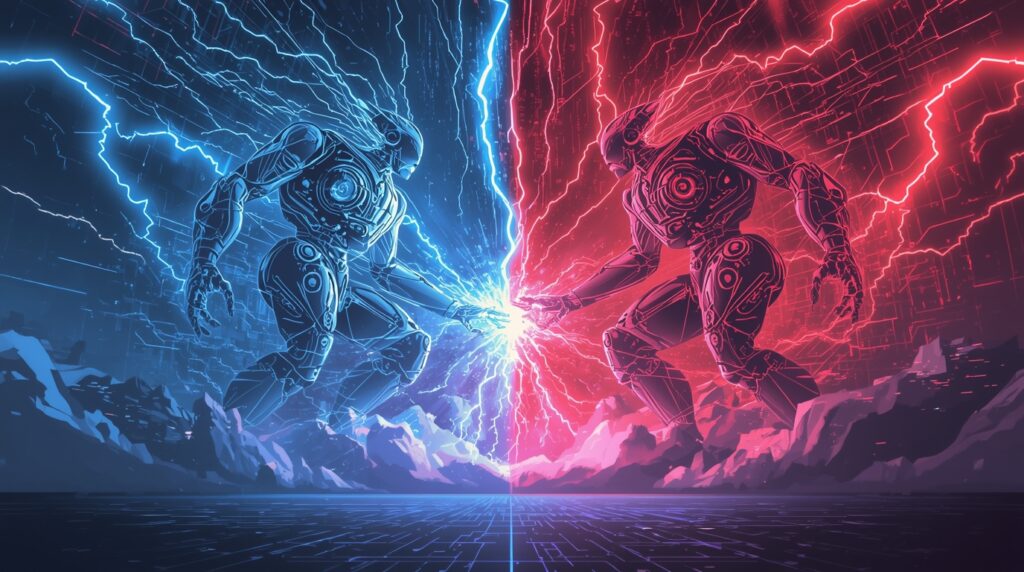
In 2025, artificial intelligence stopped being a laboratory pet trick and became the bloodstream of the global economy. Finance, medicine, classrooms, and even Hollywood scripts now pulse with its rhythms. And at the center of this transformation stand two titans locked in combat: OpenAI, the self-proclaimed guardian of humanity’s future, and Google, the elder empire of algorithms.
This rivalry is not about who sells more chatbots. It is about who defines the very grammar of machine intelligence—the rules, ethics, and infrastructure upon which the next century may be built.
The Stakes: Beyond Market Share
Whoever dominates AI doesn’t just win quarterly earnings; they gain the ability to shape the nervous system of global digital life, set ethical standards that outlive today’s engineers, and whisper in the ear of regulators and presidents, turning this competition into something far closer to Athens versus Sparta than Pepsi versus Coke.
OpenAI: The Missionary with a Corporate Halo
OpenAI began as a nonprofit dream of AGI for humanity, but along the way it transformed into a ninety-billion-dollar startup strengthened by its alliance with Microsoft. ChatGPT has already entered households like a digital roommate that can be both helpful and eerily omniscient. Its strengths lie in broad accessibility with free versions for the general public and premium tiers for ambitious users, its partnership with Microsoft acting as a Trojan horse inside every Office document and Teams meeting, and its ethics-focused branding supported by alignment research and transparency reports that function almost as a papal seal for anxious regulators. Still, its dependence on Microsoft raises questions about independence, critics argue that its mission-driven language hides aggressive commercialization, and a wave of open-source competitors continues to challenge its position.
Google: The Veteran Empire of Algorithms
Google, through DeepMind and Google Research, has shaped modern AI since the days when AlphaGo defeated the world’s best Go player in 2016. Its newest creation, Gemini 2.0, now powers not just chatbots but the full span of the Google ecosystem across Search, Gmail, YouTube and Android. Unlike OpenAI’s direct product strategy, Google’s influence works through invisibility, with AI woven quietly into daily life. Its advantages include deep integration used by billions, an extraordinary breadth of initiatives from autonomous vehicles with Waymo to quantum computing, and a massive research force exploring the frontier of deep learning. Yet it is criticized for moving slower than OpenAI’s bold releases, facing accusations of monopoly behavior and regulatory pressure, while internally navigating tensions between pure research and shareholder expectations.
Battlefields of 2025
In consumer AI, OpenAI stands strong with ChatGPT as an independent flagship product while Google counters by embedding Gemini into everyday tools and winning through ubiquity. In enterprise AI, Microsoft’s cloud alliance gives OpenAI a solid corporate foothold while Google responds with custom chips and powerful APIs. In ethics and safety, OpenAI leans heavily on its safety-first public image whereas Google places its bets on long-term research and foundational breakthroughs.
Enter the Regulators
The EU’s AI Act, the U.S. sectoral patchwork, China’s state-heavy governance—all eyes are on how these two giants bend or break under regulatory weight. OpenAI’s halo of ethics plays well in Brussels and Washington, while Google’s omnipresence makes it an easy villain for antitrust crusades.
The Open-Source Wildcards
Projects like Hugging Face and Stability AI preach transparency and community-driven development. They lack the industrial might of Google or OpenAI, but they embody a democratic ethos: AI as a commons, not a commodity. Whether they remain irritants or become serious challengers will depend on how much talent and capital they can rally.
What It Means for Us
For users, this duel promises:
- Cheaper tools as competition drives prices down.
- Faster innovation as each company tries to outdo the other.
- Better integration into daily life.
But it also threatens:
- Overdependence on a handful of corporations.
- Fractured standards making systems less interoperable.
- Ever-expanding surveillance under the guise of “personalization.”
Outlook: A War Without a Winner
Like iOS and Android, the AI industry may harden around two ecosystems: OpenAI tethered to Microsoft’s empire, Google embedding itself everywhere else. Neither will destroy the other; instead, they will shape our world in tandem, defining how intelligence itself is wielded.
Conclusion: A Rivalry that Defines an Era
OpenAI vs. Google is not merely a corporate battle. It is a struggle to define whether AI becomes a public good, a private monopoly, or something in between. In this contest, the victor won’t just write the rules of business—they will sketch the blueprint of human-machine coexistence for decades to come.